Friday, August 21, 2015

Musings of a new Sea Grant Fellow: How to pay for a human right? Social perceptions of the value of water

Greetings Sea Grant blog readers! My name is Samuel Molnar and I am the 2015-2016 Sea Grant Fellow at the Great Lakes Commission. I am currently flying through my third month at the Commission. My main project is the development of the Great Lakes Blue Accounting strategy and the scoping a pilot for the Blue Accounting Process around municipal water supply.

But first a little bit about me. I am a Michigan native. After doing my undergraduate degree in Public Affairs at Wayne State University I was a community organizer in Detroit working primarily in churches and high schools. I did this for a number of years, along with some odd jobs building mountain biking trails, before I decided to go chase down a master’s degree at the University of Michigan’s School of Natural Resources and Environment. While there I studied environmental informatics and worked on the Climate Ready Great Lakes Cities team. I also had the opportunity to be an environmental radio host with Its Hot In Here in WCBN – FM in Ann Arbor.

Throughout the past couple of months I have been working on scoping the Blue Accounting pilot project for municipal water supply. Blue Accounting is a program that supports strategic decisions, led jointly by the Great Lakes Commission and The Nature Conservancy. Blue Accounting is anchored by nine overarching desired uses of and values associated with the Great Lakes water system. These desired outcomes fall under the general categories of social values, sustainable human uses and healthy aquatic ecosystems. Blue Accounting is an information management strategy which will establish collaboratives around the desired outcomes that can agree on common goals, create and support metrics to measure progress toward the goals utilizing existing data streams, and measure progress based on those metrics.  

One of my main tasks has been to conduct interviews with directors of municipal water systems and water supply experts. There is a lot variation among the water supply systems and we hear many different perspectives. For example in water systems that were built too large for current population and industry levels such as Milwaukee’s do not prioritize conservation on the part of consumers because they need to keep pressure in their pipes and maintain revenue streams that can support system maintenance and upgrades.

The City of Guelph, Ontario on the other hand is dependent on limited groundwater and has spent decades shaping an ethic of water conservation so much so that neighbors report that having green grass during a drought is reason for social ostracization. These different perspectives, however, are both rooted in the same need for revenue to maintain infrastructure. This problem is rooted in the social perception of the value of water.

Water is both priceless, valuable beyond measure, and a basic natural resource that most believe should be available to us at a nominal fee.

This dilemma has come to a head in Detroit. I spent a couple hours at a meeting of the Great Lakes Water Authority one afternoon. The minutes from previous meetings featured public comments from groups including “The Raging Grannies” prodding the board to devise a way to end the water shutoffs that have affected thousands of Detroiters who are unable to pay their bills on time. It has been called a public health crisis and condemned by the United Nations as “a violation of the most basic human rights.”  A common refrain you might hear in Detroit’s political scene now is “Water is a human right!” Indeed it is, but it’s an expensive one. With infrastructure breaking down at an unprecedented rate, bills are rising are for the watersheds most impoverished residents.

While public officials feel the heat of public outrage and an estimated 40,000 people scramble to live without functioning water (as seen in this compelling and infuriating video by Detroit’s RaizUp Collective), the quagmire of paying for water infrastructure upgrades remains. The old and overbuilt water system in Detroit must be paid for by a smaller and less wealthy populace than it was built for. Some have called for a social campaign to help people to place more value on their water. “If only people would pay for their water half of what they pay on their cable bill”, goes the refrain. Never mind that a rising number of people, myself included have no cable bill, water is a distinctly different public utility. Unlike cable, water is a true public good; necessary to public health and welfare.  

At the Great Lakes Water Authority meeting it seemed momentarily that public officials were listening to their constituents. Extra time in the agenda was added for a presentation from one of the board members on how other communities with a large low-income population have dealt with funding water infrastructure maintenance with. One example that seems particularly promising is to model Philadelphia’s recently passed income-based policies in which low income consumers would pay a bill that is a certain percentage of their income, while more affluent consumers would pick up the tab for remaining costs.

Despite the challenges I am inspired by the many intelligent and passionate people working in the grassroots and at the top of water systems to find a way forward for water infrastructure and financing in 21st century economy. I am honored to be working alongside them.   


Friday, August 14, 2015

Hitting the six month mark

It’s hard to believe I’ve hit the halfway point in my fellowship. When I’m staring up at the burned-out fluorescent light above my cube, it seems like I’ve been here forever, and when I'm trying out a new bike route to a meeting at the Commerce Building it seems like I’ve just arrived.

The ceiling above my cube

In any event, I do feel like I’ve accomplished a lot. I am on a cross-bureau team in the Department of Commerce leading a series of workshops with businesses in coastal regions around the country. We are helping companies integrate natural capital values into their planning and operations. This work has taken me to Houston, Cleveland, and New York City, and later this fall I’ll travel to California.
20150219_100148.jpg
Houston in February > Silver Spring in February

Dr. Holly Bamford, NOAA's Acting Assistant Secretary for Conservation and Management, speaking at the Great Lakes Natural Capital Business Roundtable in Cleveland

The trips have provided some exciting new scenery for triathlon training!

FullSizeRender (2).jpgFullSizeRender (3).jpgFullSizeRender (1).jpg
Training runs in Houston Memorial Park and near the National Conservation Training Center

I’m also happy to have a project that keeps me close to my climate adaptation roots. I am working on a report with a group of NOAA researchers that synthesizes 15 years of risk communication and behavior literature, focusing on extreme weather events. We are helping transition this research to applications like better weather risk education and more effective flood and tornado warnings. In May, I traveled to the National Adaptation Forum in St. Louis to interface with more colleagues who are working on the human impacts side of climate and extreme weather.

Taking a break from the conference to visit the St. Louis Arch

I’ve had a couple of superb professional development opportunities, including science communication training from the University of Maryland Integration and Applications Network (IAN), and a facilitation training led by experts from NOAA’s Office for Coastal Management.

IMG_0431.JPG
Mouth of the Choptank River at University of Maryland's Horn Point Lab

Finally, I’m enjoying the simple things in life, like participating in scavenger hunts around the NOAA campus, and having my husband and dog (finally) move to Silver Spring.

Scavenger hunt with NOAA's Office of Program Planning and Integration (we had to "take a picture with a turtle")

I have six action-packed months under my belt, and I can’t wait to see what the next six will bring!

Tuesday, May 12, 2015

Time flies when you are having fun!

February and March were cold months in Silver Spring. Coming from Michigan, I figured that the winter weather wouldn't phase me, but Silver Spring winds definitely rival those of southeastern Michigan. Burr! There were also some icy days that left me chuckling as I skated in my sneakers down the sidewalk.  

 Slippery sidewalks!

Snow on the hand statue in front of Building 3 of NOAA's Silver Spring campus.

On the fellowship front, things have been much warmer. I am into the third month and loving it. Apart from writing the Great Lakes report section of the Comprehensive Harmful Algal Bloom and Hypoxia Research Plan and Action Strategy (a report mandated by the 2014 reauthorization of the HABHRCA or Harmful Algal Bloom and Hypoxia Research and Control Act), I have been helping to put on a HABHRCA webinar series to reach out to stakeholders for their input on needs relating to HABs and hypoxia. An additional stakeholder forum was held in person at Bowling Green State University in Bowling Green, Ohio.

I also participated in Great Lakes Day in Washington DC, at which the Great Lakes Commission, Healthy Waters Coalition, government employees, and others gathered to meet with legislators on the Hill about topics near and dear to those who care about the Great Lakes, including nutrient pollution and Asian carp.

As part of my fellowship, I have had the opportunity to spend some time at the Great Lakes Environmental Research Laboratory in Ann Arbor, Michigan. It is a fun place, with hallways and conference rooms named after places in the Great Lakes, including the St. Clair River and the Lake Superior conference room. The people are warm and welcoming.

During one of my visits to Michigan, I took a side trip to the Lake Michigan Field Station in Muskegon, Michigan.  Marine Superintendent, Dennis Donahue, gave me a tour of the station and vessels. Though the station doesn’t appear to be large, it houses a number of small and mid-sized boats that are used by federal agencies and universities for research and outreach purposes. I was impressed to find out that the station was partially powered by solar panels and wind turbines, and that the entire fleet runs on biodiesel! The engineers at LMFS are masters at stripping down vessels and building them back up with updated hardware to suit the science needs of the NOAA researchers. My favorite vessel was the 41-year-old SRV (small research vessel) Laurentian, a boat I had heard about from my mentors at the University of Michigan, but had never seen in person until now.
 SRV Laurentian - laden with science equipment, ready for the field season.
 SRV Laurentian
 SRV Laurentian - the bench where samples are processed.
SRV Laurentian

We also had a Knauss event that included Knauss Alumni and Sea Grant staff at the National Botanic Garden. We had the entire gardens to ourselves and ample opportunity to catch up with fellows from placement week and to meet new people. Its warmth and greenery was a nice reprieve from the cold, windy world outside. I connected with some people whose names I had been seeing while I did the information searches for the HABHRCA report.

 Orchids at the United States Botanic Garden
Orchids at the United States Botanic Garden
The Botanic Garden was lit up at night for the Knauss Alumni event

Another exciting aspect of the fellowship is the professional development activities. One notable event was the DC Science Writers Association Professional Development Day. I am not a science writer per say, but since I have a general interest in science writing and communications, I was pleasantly surprised to find that the workshops were useful for someone at my level, who doesn’t yet have formal science writing experience. We talked about good versus bad story pitches and what it meant to be a good editor.

Looking forward to more fun as the fellowship continues!

Wednesday, January 7, 2015

Happenings on New Hampshire's Seacoast

A little Coastline Packs a Punch
New Hampshire's Seacoast isn't known for its size (~17 miles of Atlantic coastline). It is known, however, for its vibrant surfing and kayaking communities, its real working waterfronts and Naval Shipyard, and its tight-knit, historic, New England towns. It's these valuable assets, among others, that I've been working to better understand and protect over the past 16 months as a NOAA Coastal Management Fellow with the New Hampshire Coastal Program.

A fall day at the beach in Rye, NH

A lot of my time has been spent working with the NH Coastal Adaptation Workgroup (CAW)--a partnership of 20 organizations all focused on helping communities prepare for the impacts of climate change. This group rocks. Their approach is incredibly effective--they translate the science for community decision-makers (read: board of selectmen, town planners, zoning boards, planning boards, conservation commission members) and facilitate workshops to help others make plans to prepare. It's the first effort I've come across that takes the time to understand what communities really need and designs ways to meet those needs. In addition to an effective approach, CAW members are energetic, driven, and funny. For a little more insight into their work, here's CAW's web page and blog: nhblog.stormsmart.org.
Photo by Ron Sher taken in Hampton, NH. Winner of the 2014 Gulf of Maine King Tides Photo Competition.

Managing a Shoreline for Change
Aside from 'resilience', one of the hottest topics/terms in coastal management right now is 'living shorelines' (or green shorelines, or soft shorelines, or whatever synonym you like). As sea levels rise and coastal storms intensify with climate change, natural resource managers are incredibly interested in finding ways to protect communities from flooding and erosion while also preserving habitat and ecosystem function. You've likely seen some living shoreline designs coming out of New York City in the wake of Hurricane Sandy. That's the idea. Use oyster reefs and dunes and salt marshes in the place of or in concert with harder, more traditional shoreline management structures like seawalls and revetments. Help communities learn to 'live with water' by raising homes or retreating rather than keeping the water out with flood gates.

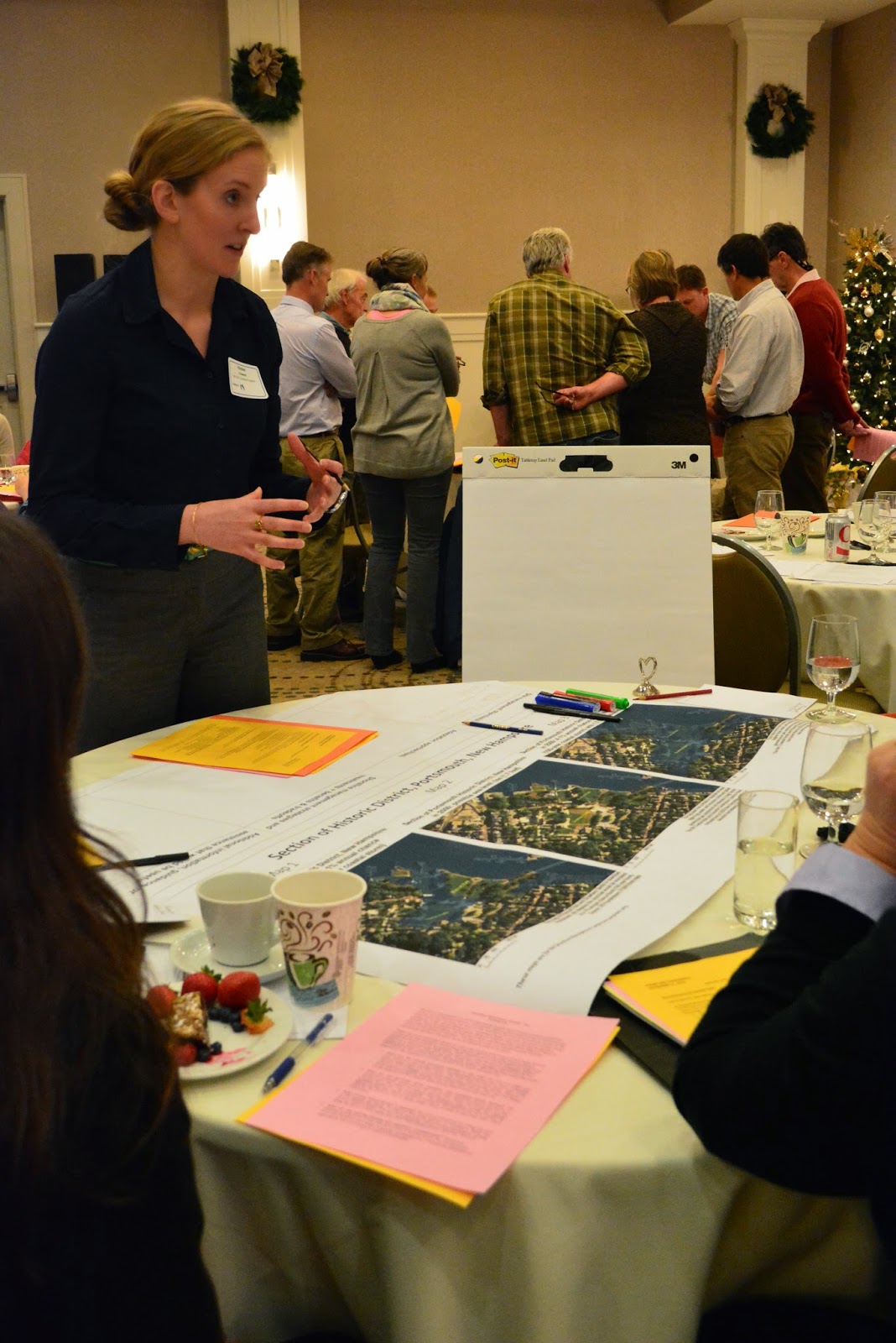
CAW, the NH Coastal Program, and the Great Bay National Estuarine Research Reserve wanted to start a dialogue about these emerging and innovative shorelines management strategies, so we organized a conference last month to do just that. I was on a team that designed the agenda, identified speakers, and made some maps showing predicted sea-level rise in vulnerable NH Seacoast locations for an interactive exercise. With over 100 participants, the conference was a success, and I'm looking forward to working on some of the next steps we identified to keep the conversation moving. One of the first steps is to create a high resolution inventory of the NH shoreline--not just the 17 Atlantic coast miles, but also the 200+ miles of estuarine shorelines in the Great Bay and Hampton-Seabrook estuaries. We need a detailed understanding of what's there now before we can think about which shorelines strategies might work and where.


Facilitating an activity at the NH Shoreline Management Conference

What is the value of it all?
And finally, my fellowship project. What an interesting, challenging, and rewarding experience it's been so far. I'm managing an integrated assessment of the ecosystem services in the Great Bay estuary. We have a project team of five people and an Advisory Committee of 20+ folks. Together, we have run an initial model to evaluate habitat risk of eelgrass, oysters, and salt marsh today.

Counting oyster spat at the UNH Jackson Estuarine Lab
Now we're getting into a really fun part of the assessment: designing future scenarios. I say fun because I get to ask people who generally spend their time focused on the realistic and practical limits of their work to be imaginative and hypothetical. We get to draw on maps. We get to make things up. All in the name of curiosity. Ultimately the goal is to be able to explain the value that these habitats provide for people in the area (values like carbon sequestration and storage, coastal protection, fisheries, recreation, and nutrient filtration), and to show how that value could change under different management scenarios and sea-level rise. Will we be able to do it? I'll check back in 6 months or so and let you know.

A salt marsh in Great Bay, NH


Best of luck if you're applying for a fellowship! Feel free to shoot me an email if you have any questions about my experience or the application process (kirstenbhoward at gmail dot com).   

Thursday, January 1, 2015

Great time at Placement Week

Placement week was just as everyone described; exhausting, but fun. Favorite parts? Meeting my fellow Fellows, getting to know the people in a handful of offices at interviews, and getting a chance to check out D.C. and Silver Spring. Everyone is interesting and accommodating. Many facilitators and interviewers involved in the process have been fellows themselves, and so are extra-understanding. While it is good to prepare with the proper clothes, snacks, etc., the most useful thing was having an open mind and going with the flow. With a full day of host presentations, fourteen interviews, and social events every evening, there isn’t much time to be stressed. The week is over before you know it and at the end not only do you have an exciting new job, but you already know some people you will be working with and are generally oriented to the DC area.

I was excited to be placed with Great Lakes Environmental Research Laboratory, working on a report to update Congress on recommendations for actions to prevent harmful algal blooms and hypoxia in the Great lakes. I will be based in Silver Spring and travel to Ann Arbor, Michigan periodically where I will connect with researchers and other stakeholders to gather information for the report. With a background in harmful algal bloom studies, the topic couldn’t be a better fit for my interests. 

I am glad I stayed a couple extra days to look for housing and childcare around Silver Spring. Touring apartments was helpful, but even more helpful was getting a feel for each part of the city in the daytime and at night.

I am looking forward to starting the fellowship in February and living in a vibrant metro area with great food and lots to do!

Monday, December 8, 2014

#isurvivedplacementweek (Executive Branch)


Hi everyone!

I made it back alive from that crazy adventure in DC known as Knauss Placement Week. We had all been warned about what a whirlwind it is, but you really don’t feel the sorority rush/hunger games (kidding, it’s not that brutal) nature of it all until you are surviving placement week. Placement week brings out a bag of emotions. It’s exciting, stressful, fun, exhausting, educational, challenging, and very rewarding. Each day flies by, but this one week feels more like two. At the end of the ride, you walk away with quite an eventful week, quite a unique experience to look back on and, not to mention, great contacts and a fantastic new job! You also become very familiar with the DC metro system (you might have to learn how to get from one side of the DMV (DC, Maryland, Virginia) area to the other in a very short amount of time) and get a little sample of some bars in the area through the happy hour/dinner socials.    

#maytheoddsbeeverinyourfavor
Placement week eased us into the madness, starting off with dinner on Sunday night with only the other Knauss finalists and the Sea Grant staff. We got a chance to meet and briefly talk to everyone, and also got the run-down of the schedule for the week. Monday was jam-packed with 50+ ten minute presentations from all of the host offices on the available positions. After trying to digest that onslaught of information, on Tuesday morning we scheduled our minimum of 12 interviews over the next few days. Despite being pretty much a free-for-all sign up process, the scheduling went fairly smoothly. As soon as the scheduling was complete, the interviews began! For the rest of the day Tuesday through mid-day Thursday, I interviewed for 14 different positions in various NOAA offices, at the EPA, at NSF, and at the US Army Corps of Engineers. If the interview gauntlet wasn't mentally exhausting enough, as soon as we finished the marathon on Thursday we had to choose three offices to call back that afternoon to say that they were in our top three. Placement ended Friday morning with the matching process when we got to see how the host offices ranked all of their interviewees. Finalists who were ranked #1 had the first shot at the position. If the finalist took it, the finalist crossed his/her name off of the other lists and the process moved forward from there. Chances are you will be near the top (if not #1) of a few lists. It seemed very intimidating at first, but the Sea Grant staff and all of the other finalists were so supportive. At the end of the morning, we officially became fellows!

We hardly got a chance to relax during the week. At the end of every day was a happy hour/dinner social that the hosts attended so we could talk to them more about whatever we didn't get a chance to during the short 30 minute interviews. If you aren't the best networker, push yourself to talk to your favorite offices. It's important to take advantage of these opportunities to talk to the hosts in a social setting. These “dinner” socials were kind of crazy (I ended up eating dinner after the socials around 9/9:30 every night at a different restaurant), so I recommend eating dinner beforehand if you can. The social on Thursday night after making your call-backs is a bit of a shark tank, so prepare to be hounded by the hosts. It’s a wild week, but just remember: they want you (there are more positions than fellows!), you get the opportunity to learn about and network with so many different federal offices (when else could you say you had interviews with NOAA, NSF, USGS, EPA, USACE and Dept. of State?), and you get an awesome job at the end!
Dinner social at Vapiano in Chinatown!

Lunch at Union Station after the last of my 14 interviews!

#feeltheforce
I ended up accepting a position as the Modeling Analysis Prediction and Projections (MAPP) Program Fellow in the NOAA Climate Program Office! It was definitely a tough decision. I could see my year going in so many different directions with the wide range of incredible opportunities in various offices, but I had to “feel the force”. The Sea Grant placement week staff will advise you all week to trust the system, stay open and feel the force (all of which you should follow!). Past fellows have ended up with positions they did not expect, but no one seems to have been disappointed. As for making that decision on the last day or when you're picking your three call-backs (these calls carry a lot of weight in the hosts' rankings of their interviewees), think about flipping a coin over two of your options; which one would you be more disappointed to lose? Feel the force.

My recent background is in aquatic conservation ecology (mostly freshwater) and environmental informatics (GIS, remote sensing, statistics, modeling). My master’s project at U of M-SNRE focused on developing a land conservation plan to protect the water quality of the Kalamazoo River Watershed based on the results of an ArcGIS model. However, I grew up a weather nerd (and a math nerd) and almost specialized in atmospheric sciences in undergrad, but other opportunities took me in a different direction. So, I am very excited to work in the Climate Program Office on the MAPP team for my fellowship year! 

View of the Capitol at night from Union Station
 
#knaussmafia #VIP
After Knauss fellow initiation (aka Placement Week), we got the official welcome into the Knauss Mafia or "The Family". I already got an idea of the significant presence and extent of the Knauss Mafia in NOAA and throughout DC during placement week, and I am sure that was just the beginning. Knauss fellows are everywhere! It was really exciting to see where some of these former fellows have ended up. I could truly sense the strength of this support network. Seeing "the mafia" definitely got me hopeful for the future, post-fellowship. 

After that wild ride, I am now back in Ann Arbor, Michigan working at Michigan Sea Grant for a few more weeks until I make the move to DC! I am a Northern Virginia native, so I am excited to move back to where I grew up. I can't wait to hang out with the 2015 class of Knauss fellows and for this new adventure to begin! 
Celebrating the end of placement week with the 2015 Knauss Fellows!

Shout out at our last dinner social on U Street in DC!


Monday, December 1, 2014

Nearing the end of my Knauss Fellowship

Placement week for the 2015 fellowship class was two weeks ago, a sure sign that the end of my fellowship year is near. It was interesting to see the new fellowship class from the other side of the fence, especially since my office was recruiting a "new" me and I sat in on the interviews. Time sure flies....

What's new?
A lot has happened since my last post. Here's a list of some of my activities from the last 10 months, both professional and fun:
  • Helped to organize the 2014 Ballast Water Collaborative meeting in Silver Spring, MD
  • Volunteered at the NOAA Heritage Days 
  • Organized a Knuass Fellow river cleanup and canoe trip on the Potomac River
Cleaning up the Potomac River with the 2014 Knauss Fellows

  • Attended a Hazard Analysis and Critical Control Point (HACCP) training for invasive species at the USFWS National Conservation Training Center
  • Attended the NSF Long Tern Ecological Research mini-symposium
  • Attended "Insights into the making of state and federal climate policy" symposium at Georgetown Law
  • Attended the 2014 Public Policy Forum-The Urban Ocean, hosted by the Consortium for Ocean Leadership
  • Attended the Capital Hill Ocean Week
  • Attended ~6 hearings and briefings on the Hill related to invasive species
  • Volunteered with the Smithsonian Environmental Research Center's Marine Invasions Lab

 
White catfish from the Chesapeake Bay
  • Took Project Design and Evaluation training hosted by the NOAA Digital Coast
  • Gained a certificate in federal appropriations law
  • Attended the Environmental Law Institute's "Summer School" program
  • Reviewed GLRI grants
  • Gave a NOAA Science Seminar presentation on my graduate research
  • Designed invasive species fact sheets
  • Published 4 invasive species articles on the NOAA Fisheries homepage: 
  • Spent 17 days at sea aboard the NOAA Ship Henry B. Bigelow performing the Gulf of Maine/Georges Bank Autumn bottom trawl survey
 Cod!
  • Attended the Great Lakes Panel on Aquatic Nuisance Species spring meeting at Notre Dame and took an invasive species risk assessment workshop alongside the meeting
  • Attended two Aquatic Nuisance Species Task Force meetings in Washington, DC. Wrote both reports
  • Attended the Invasive Species Advisory Committee meeting in May 2014 
  • Assisted with an invasive species risk assessment of African longfin eels
  • Busy organizing a 2015 NOAA Aquatic Invasive Species Team Workshop in Santa Cruz, CA
It has been a very unique experience thus far. I've done everything from track legislation to drag up flounder and skate from the bottom of the ocean (look for a separate write up on this)!  I don't know how else I ever could have gained the variety of experiences that I have during my fellowship.

How I spent my free time

I've had a blast living in DC. I was a little apprehensive about it at first, but the city has grown on me a bit. I love fly fishing, hiking, canoeing, etc. These don't seem like things that you can do in DC. I was wrong. I met some great friends through the local Trout Unlimited chapter, the Tidal Potomac Fly Rodders group, and the Potomac River Smallmouth Bass Club. I've explored the region pretty extensively and have learned to love it. I currently own fishing licenses in DC, Virginia, West Virginia, and Maryland, including trout stamps and coastal fishing licenses as needed. I've caught brook trout, rainbow trout, brown trout, smallmouth bass, largemouth bass, striped bass, American shad, and a number of other species in the productive waters along the east coast. Here's a couple of my favorite shots:
 Striped bass in the Potomac River right off of Fletcher's Cove
 Catching carp on mulberry flies in Georgetown
Brook trout from the Blue Ridge mountains

There's also excellent birding along the coast, great camping/hiking at Assateague National Seashore, good crabbing at Sandy Point State Park in Maryland, and endless other opportunities in the tidal Potomac. Some of the most fun outdoor activity close to DC is the National Arboretum. I love bringing a blanket and book to the Arboretum and laying out in the grass on a sunny weekend afternoon. I highly suggest hiking the wildflower forest during the spring bloom! Also, you can't afford to miss Great Falls, especially during a big spring flood or during summer when the whitewater kayakers are plunging over the waterfalls.

What's next for me?

Next week I'm off to Florida to tour the Army Corps of Engineers invasive species efforts in the Everglades. The region suffers from invasive plants and animals, including large pythons! Will post a blog with pictures when I get back. Then I'll be wrapping things up in the office for the season before I travel back home for the holidays. January will be busy, as I'll be hard at work coordinating a workshop for all the NOAA invasive species professionals that will take place in the spring.

I'm now applying for lots of jobs. The best part about my fellowship is that I've been able to network with invasive species experts across federal, state, and non-profit organizations throughout the country and hopefully those connections will lead to a rewarding career. It is hard to say where I'll end up!

Friday, June 20, 2014

Field Trip!

As part of my NOAA Coastal Management Fellowship with the San Francisco Bay Conservation and Development Commission's Adapting to Rising Tides program, I am leading the Hayward Resilience Study.  The study has conducted sea level rise vulnerability and risk assessments for two parks, extensive marshes, utility lines and transportation assets along the Hayward, California shoreline.  The entire shoreline area is at low elevation (less than 48" above current mean higher high water) and is vulnerable to sea level rise impacts before 2100.  

Erosive fringing marsh at Hayward Regional Shoreline
After we completed the interviews and research for the vulnerability and risk assessment, we went on a field trip to look at the landscape together and think about connections between different agencies and assets.  Working group members had the opportunity to share their own key vulnerabilities such as eroding marsh fronts, levees with overdue maintenance, and water sensitive electronics within the flood plain.  The field trip helped ART staff and working group members understand which adaptation strategies they can do alone and why, for long term resilience, they need to work together to find a shoreline-wide solution.
Hayward Resilience Study working group members

For more information on my fellowship or the Adapting to Rising Tides Program please visit www.adaptingtorisingtides.org or contact me at maggiew@bcdc.ca.gov

Wednesday, February 26, 2014

A great year as a Knauss Fellow


What a year it’s been!  With my fellowship coming to an end this month, I can say that the Knauss Fellowship exceeded all of my expectations.

It was a busy year getting to know the DC area and my fellow fellows, and getting immersed in the ocean community here.  I also got to meet an astronaut – Kathy Sullivan (see photo), who leads the National Oceanic and Atmospheric Administration and became the first American woman to walk in space.

And oh yes, there was also quite a bit of learning at work as well.  At the Office of Marine Conservation at the Department of State, I worked with a group of very smart, talented and committed colleagues.  They were terrific in involving me in the office’s day-to-day duties while also allowing me the opportunity and flexibility to pursue my own interests.

I got to work on projects to raise awareness of marine debris by involving U.S. embassies in beach cleanup activities, create a public-private partnership that will develop mobile phone applications to improve the sustainability of small-scale fisheries overseas, and plan a speakers’ panel for an international oceans conference.

I also had the chance to participate in U.S. delegations to international fisheries negotiations.  I participated in delegations to the Western and Central Pacific Fisheries Commission in Japan, the North Pacific Fisheries Commission in Taiwan, the International Commission for the Conservation of Atlantic Tunas in South Africa, the Yukon River Panel in Canada, and the South Pacific Regional Fisheries Management Organization (SPRFMO) in Ecuador.  Each negotiation was very different and a terrific learning experience.

At SPRFMO, which took place during the second-to-last week of my fellowship, I served as the sole State Department representative to the delegation, which also included NOAA representatives from headquarters and the Pacific.  Because SPRFMO is still a new organization, many of the discussions focused on developing measures to monitor the activities of fishing vessels, ensure compliance with conservation measures, and gather data about the resource.  It was an up close and personal view of how distant water and coastal fishing nations are responding to United Nations resolutions to improve their cooperation with respect to the conservation and management of marine resources in international waters.

I’m very thankful for the opportunity provided by the fellowship and the Office of Marine Conservation, which gave me a unique introduction to the international ‘fish world.’  I’ve loved it.  Not only does it involve iconic species like tuna and salmon, but it touches on international law, cutting-edge science, social and economic systems, and the individual choices of people in many nations.

I would strongly encourage students interested in marine policy and science to apply for the Knauss Fellowship.  The experience and the people you meet are fantastic.

Dave Gershman
Knauss Marine Policy Fellow
(2/2013 – 2/2014)

Saturday, February 8, 2014

First week as a Knauss Fellow

Well, I'm all moved in and unpacked. I've already learned some valuable lessons about living in DC:
  • First, on-street parking requires permits- especially for big moving trucks. I tried to time my move so that I could show up in DC before rush hour and get a parking spot, but it didn't work out. The parking permit folks feel no sympathy for unaware out-of-towners, so I had to risk parking a 17ft moving truck without a parking permit (which requires 72hrs prior notice to get! How do you do that before you move here?). It all worked out and I made it through without a ticket!
  • Second, things labeled as "close to the metro" or "ample street parking" seem to be sales gimmicks used by folks posting housing ads on Craigslist (which, by the way, are mostly scams, so beware). I moved into the city and commute to NOAA in Silver Spring. My apartment seemed close to the metro on Google Maps, but it didn't turn out to be so true. Luckily the bus system here is excellent and I don't need to take the metro rail. I hop on a bus (half the price of the metro rail! Really adds up when you commute 5 days a week) and get to work in a half an hour.
  • Reddit has excellent information for those moving to the DC area, but I didn't find it until after I moved here. Here is the link, it also has lots of good information for once you're here: http://www.reddit.com/r/washingtondc/
Now, lets talk about my position...

Here's my office: DOC > NOAA > NMFS > Office of Management and Budget. Peg Brady, my boss, is the NOAA policy liaison to both the National Invasive Species Council and the Aquatic Nuisance Species Task Force, in addition to many other duties. I'm working with her team on invasive species issues and am already loving my job. I've been reading like a madman to get caught up on their management plans, strategic plans, and cross-cut budgets. Meetings have been interesting so far, as everyone seems to talk a different language because of all the acronyms they use. I have a few papers pinned above my desk that spell out most of the acronyms they use, but it is going to take some time to figure it all out!

The resumes of the people I work with are impressive. The assistant administrator of NOAA was the first American woman to travel to space- try topping that! I'm looking forward to the next year, and am sure I'll have a lot more to report on next time!

Clarence
Knauss Marine Policy Fellow
(2/2014 – 2/2015)
Fulla1cd@cmich.edu