Editor's note: This post was jointly written by 2023 interns Hadley VandeVusse and Ava Tackabury. Photo credits go to Ava Tackabury.
 |
| Hadley VandeVusse |
This summer I was given the opportunity to work with the Michigan Department of Natural Resources (MDNR) on a research project studying Lake Trout population dynamics in Northern Lake Michigan. The study involves the use of acoustic telemetry to track the movement of the fish. It is necessary to gather more information about the movement ecology of Lake Trout for effective fisheries management. If we know what habitat fish like to occupy and how they traverse across areas it allows us to better implement harvest limits, refuge boundaries, and so much more. I am so lucky to be able to work on such an interesting project with an amazing team and in one of the most beautiful places in the country.
-----
 |
| Ava Tackabury |
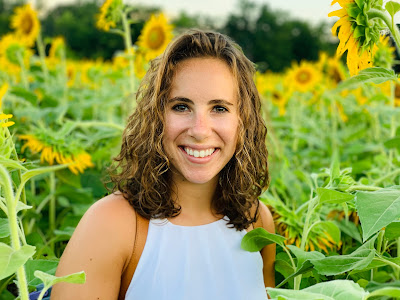
My name is Ava Tackabury and I am studying Earth & Environmental Sciences and Anthropology at the University of Michigan. I connected with Michigan Sea Grant earlier this year and am now stationed in Charlevoix, MI for a summer internship with the Michigan Department of Natural Resources (MDNR). Throughout my academic and personal journey so far, I have found that my interests lie where the natural and anthropogenic worlds become entangled—where species meet. It was this intrigue that drew me to my current research project, a multi-faceted approach to understanding the potential for future Lake Whitefish river spawning in Lake Michigan tributaries. Historically, Lake Whitefish used to travel upstream in Lake Michigan tributaries to lay their eggs each fall. Following mass habitat destruction from 19th-century logging and damming activity, however, there has been a dramatic Lake Whitefish population decline including the near loss of river spawners. Through our research, we seek a better understanding of the remaining river spawning habitat potential for Lake Whitefish so that future efforts can help to reestablish these historic spawning runs. Working with all of my project partners (MDNR, WDNR, The Nature Conservancy, the Sault Ste. Marie Tribe of Chippewa Indians, and the Little Traverse Bay Bands of Odawa Indians) has been a pleasure and I have quickly fallen in love with all that northern Michigan has to offer.
S/V STEELHEAD LAKEWIDE ASSESSMENT PLAN:
This summer, we have also been able to participate in several research projects currently being conducted at the Charlevoix Fisheries Research Station. A few weeks ago, we had the opportunity to accompany our boat crew on the S/V Steelhead, Michigan DNR's survey vessel in Charlevoix, during the annual Lakewide Assessment Plan (LWAP). Each year, the Steelhead studies adult yellow perch, lake whitefish, lake trout, Chinook salmon, and forage fish populations at a few Lake Michigan ports. The sampling year begins with the spring gill net survey in a collaborative assessment with other Lake Michigan agencies. Since 1997, the LWAP survey has provided MDNR with a comprehensive understanding of the status of adult Lake Michigan fish populations through a multispecies focus.
.jpeg) |
| Click the links for more information on SV Steelhead Assessment Work or a video detailing SV Steelhead Bottom Gillnetting. Photo: Ava Tackabury |
A DAY ON THE S/V STEELHEAD:
6:00 am:
We started the day bright and early. At the research station before heading to port, we gathered our gear— personal floatation devices (PFDs), bibs, coats, boots, and lined gloves. We then loaded all of the coolers with ice to prepare them for fish collection later on. Once everything was loaded and ready to go, we hopped in the truck excited for the day ahead. It was a short drive from the station to the port where the Steelhead awaited our arrival. We quickly transferred all of our gear and the coolers onto the boat, untied the lines, and headed through the Pine River channel into Lake Michigan.


8:00 am:
Our destination was just north of the Charlevoix port, where the crew had set gill nets a day prior, so we had a little time to relax before the grunt work began. During the ride, we enjoyed some yummy donuts under the sun. We traveled until we could see our first buoy (marked by a red flag) that indicated the start of a gill net before springing into action.


9:00 am:
Once we reached the first buoy, the captain skillfully aligned the vessel with the gill net. A gill net is a wall of netting that hangs in the water column designed to allow fish to get only their head through the netting, but not their body. Using the lift machinery in the hull of the boat, we were able to pull in the gill net catch for sample collection. As the nets were rolled up into the vessel, we had to work quickly alongside the crew to untangle the large adult fish from the net.
Hadley: “Just when you thought you had them untangled from the nets, they would decide to wiggle around and you were back to ground zero again.”
Suckers, Lake Trout, and Lake Whitefish made up the majority of our catch (though we did manage to score one Burbot). We placed the fish in designated bins correlated with the specific mesh size and net depth at which they were caught. The crew said that the amount of fish we caught was a typical light catch, but the fact we pulled up that many in one day still astounded us.


12:00 pm:
Once we finished pulling all the gill nets, set the day prior, we moved the fish to the stern, loaded them into coolers, and put them on ice. Then, we brought the fish coolers into the wet lab where we “worked-up” the fish, taking various measurements and samples to be sent to the labs for later analysis. We took size measurements, coded wire tagged snouts, stomachs, otoliths, and maxillaries for all the fish, depending on the species and algorithm count requirements per species. To ensure the fish were not completely wasted after being sampled, we filleted and bagged the fish to give to the local community. Fresh Lake Trout is even more delicious when it benefits the scientific world.

3:00 pm:
After taking all of the required fish samples, we ended the day cleaning everything. All coolers, mats, counters, scales, and floors were scrubbed and hosed down. We also cleaned out the whole gill net lift room in the hull of the vessel as we pulled up a lot of zebra and quagga mussels that made quite a mess. Finally, after all the cleaning was complete and a quick snack break, it was time to cap off the day. Tiredly, we unloaded all the equipment off the boat and headed home, both of us satisfied with our work from the day.
After taking all of the required fish samples, we ended the day cleaning everything. All coolers, mats, counters, scales, and floors were scrubbed and hosed down. We also cleaned out the whole gill net lift room in the hull of the vessel as we pulled up a lot of zebra and quagga mussels that made quite a mess. Finally, after all the cleaning was complete and a quick snack break, it was time to cap off the day. Tiredly, we unloaded all the equipment off the boat and headed home, both of us satisfied with our work from the day.


.jpg)